

Can Physiotherapy Help With Knee Pain?
Knee pain is one of the most common reasons people seek physiotherapy — and for good reason. The knee is one of the most used and most vulnerable joints in the body, subjected to significant forces during everyday activities, physical work, and sport. Whether your knee pain developed gradually over time or came on suddenly after an injury, physiotherapy offers a well-supported, conservative path toward recovery.
The short answer to the question is yes — physiotherapy can help with a wide range of knee conditions. For many people dealing with knee injuries in Newmarket and across York Region, whether related to sports, work, or daily activity, physiotherapy provides effective treatment without the need for medication or surgery in many cases.
Common Causes of Knee Pain
Knee pain can arise from many different structures within and around the joint, and identifying the source is an essential first step in developing an effective treatment plan. Some of the most frequently seen causes of knee pain in physiotherapy include:
Ligament injuries, such as ACL, MCL, or LCL sprains and tears, are common in sports that involve cutting, pivoting, and contact. Meniscus injuries — damage to the cartilage discs that act as shock absorbers within the knee — can occur through sudden twisting movements or through gradual wear over time. Patellofemoral pain syndrome, sometimes called runner’s knee, involves discomfort around or behind the kneecap and is common in both athletes and active workers. Patellar tendinopathy affects the tendon connecting the kneecap to the shinbone and is frequently seen in jumping sports and physically demanding occupations. IT band syndrome causes pain on the outer side of the knee and is common in runners and cyclists. Osteoarthritis involves the gradual breakdown of cartilage within the knee joint and is one of the most prevalent causes of chronic knee pain in adults.
Each of these conditions has a distinct presentation and requires a tailored approach to treatment — which is why an accurate assessment is always the starting point for physiotherapy care.
Conservative Treatment Approaches
Physiotherapy is considered a first-line conservative treatment for most knee conditions, meaning it is typically the appropriate first step before considering more invasive options such as injections or surgery. For a significant proportion of patients, conservative physiotherapy treatment is sufficient to achieve meaningful recovery and return to full function.
The goals of conservative treatment for knee pain are to reduce pain and inflammation in the early stages, restore normal joint mobility and movement mechanics, rebuild strength and stability in the knee and surrounding structures, and return the patient to their desired level of activity safely and durably.
Conservative care respects the body’s natural healing process while providing the structured support and progressive challenge needed to achieve the best possible outcome. It is appropriate for both acute knee injuries and long-standing chronic knee conditions.
Exercise Therapy
Exercise is the cornerstone of physiotherapy for knee pain. A well-designed exercise program addresses not only the knee itself but the broader kinetic chain — the hips, glutes, core, and foot — all of which influence how the knee is loaded during movement.
For knee pain, common areas of focus include strengthening the quadriceps, which are critically important for knee stability and shock absorption; the hamstrings, which protect the ACL and support knee function during dynamic movement; and the hip abductors and glutes, which control the alignment of the knee during weight-bearing activities. When these muscles are weak or not activating effectively, the knee compensates in ways that increase stress on the joint and its structures.
Exercise programs for knee pain are introduced gradually and progressed systematically, ensuring that the knee is being appropriately challenged without being overloaded. For athletes managing sports-related knee injuries, the program will advance through sport-specific phases before return to play. For patients with work-related knee injuries, exercises are designed to restore the capacity needed for the physical demands of their job.
Home exercise programs play an important role in rehabilitation — consistent work between appointments is a significant factor in how quickly and completely patients recover.
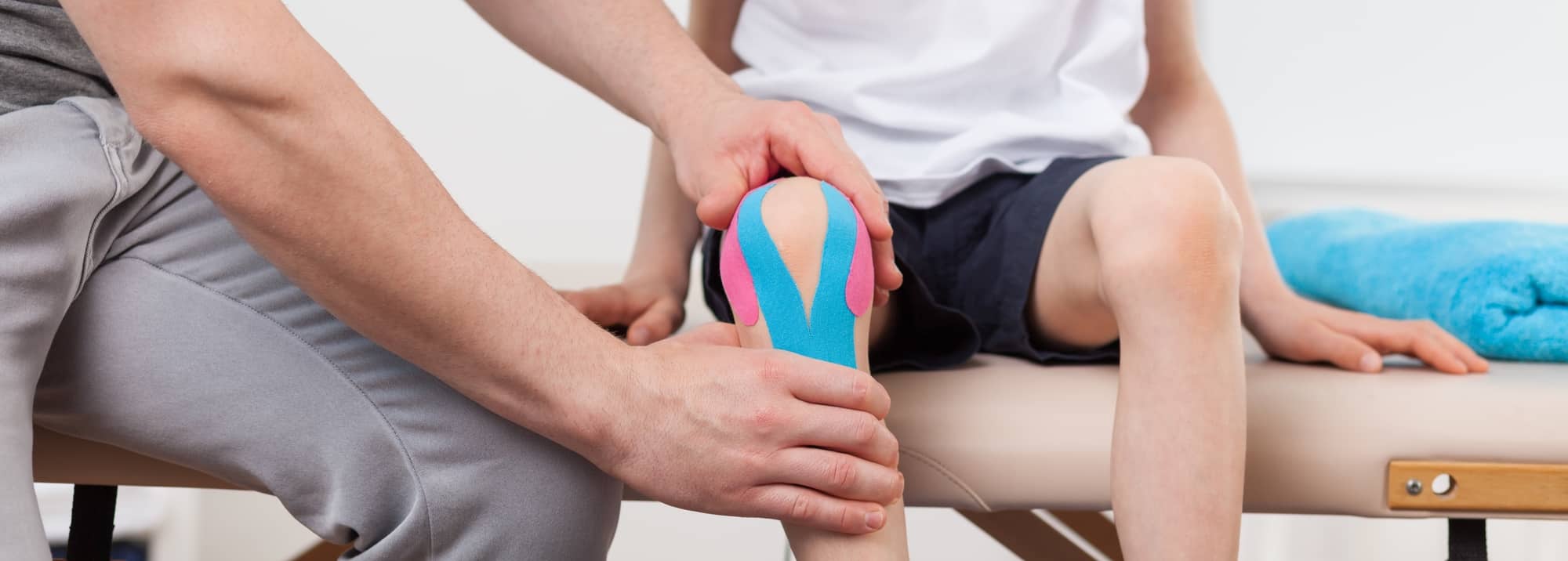
Physiotherapist applying kinesiology tapes for painful knee
Manual Therapy
Manual therapy refers to hands-on techniques applied by a physiotherapist to improve joint mobility, reduce pain, and address restrictions in the soft tissue surrounding the knee. It is often used in the earlier stages of treatment when pain and stiffness are more limiting, and can make it easier for patients to engage in and benefit from exercise therapy.
Techniques used in manual therapy for knee pain may include joint mobilization, in which the physiotherapist applies controlled, graded movements to the knee joint to restore mobility and reduce stiffness; soft tissue techniques targeting the muscles and connective tissue around the knee, including the quadriceps, hamstrings, and IT band; and patellar mobilization, which addresses restrictions in how the kneecap moves within its groove — a common contributing factor in patellofemoral pain.
Where appropriate, manual therapy to the hip or lower back may also be incorporated, as dysfunction in these areas can directly influence knee mechanics and pain.
Activity Modification
One of the most practical and immediately impactful components of physiotherapy for knee pain is guidance on activity modification. This involves adjusting — rather than eliminating — the activities that load the knee, in ways that allow the joint to continue to be used while reducing the stress that is aggravating symptoms.
For athletes, this might mean modifying training volume, intensity, or the type of activity during rehabilitation. A runner with patellofemoral pain, for example, may be guided to reduce mileage temporarily, adjust running surfaces, and substitute lower-impact cross-training while the knee recovers and strength is built.
For patients with work-related knee injuries, activity modification is particularly important. Many physically demanding occupations involve prolonged kneeling, squatting, lifting, or walking on hard surfaces — all of which can aggravate knee conditions. A physiotherapist will provide practical strategies for modifying these tasks, advise on appropriate use of knee supports where indicated, and work with the patient on a graduated return to full work duties.
Education on activity modification also includes guidance on rest — specifically, how much rest is helpful and when continued movement is more beneficial. For most knee conditions, complete rest is not the optimal approach. Keeping the joint moving within a tolerable range, while avoiding activities that significantly aggravate symptoms, supports healing and prevents the deconditioning that prolonged rest can cause.
The Role of a Personalized Treatment Plan
No two people with knee pain present identically. The structure that is injured, the severity of the condition, the patient’s age and fitness level, the demands of their sport or occupation, and their goals for recovery all influence what treatment should look like.
At Spectrum Physiotherapy, each patient with knee pain receives a thorough assessment before any treatment begins. This assessment identifies the source of the pain, the contributing factors, and the patient’s specific functional limitations. From there, a personalized treatment plan is developed that combines the most appropriate elements of exercise, manual therapy, activity modification, and education for that individual.
Plans are reviewed and adjusted as recovery progresses, ensuring that treatment continues to reflect where the patient is and what they need at each stage of rehabilitation.
Frequently Asked Questions
Should I rest completely when my knee is painful? Not usually. While some reduction in activity is often appropriate in the early stages of a knee injury, complete rest can lead to muscle weakness and joint stiffness that slows recovery. Your physiotherapist will guide you on what activity is appropriate for your specific condition.
Can physiotherapy help knee pain without surgery? For many knee conditions, yes. Physiotherapy is an effective conservative approach that avoids surgery for a significant proportion of patients. Even in cases where surgery is ultimately required — such as ACL reconstruction — physiotherapy both before and after the procedure plays an important role in outcomes.
How long does it take to recover from a knee injury with physiotherapy? Recovery timelines vary considerably depending on the type and severity of the injury. A mild sprain or muscle strain may resolve within a few weeks; conditions such as ACL tears or significant meniscus injuries may take several months. Your physiotherapist will give you a realistic expectation based on your assessment.
Is physiotherapy appropriate for work-related knee injuries? Yes. Physiotherapy is well-suited to managing work-related knee injuries and supporting a safe return to the physical demands of employment. Treatment is tailored to the specific requirements of the patient’s occupation and can be coordinated with workplace health or WSIB processes where relevant.
Can older adults with knee osteoarthritis benefit from physiotherapy exercise? Absolutely. Exercise is one of the most consistently supported treatments for knee osteoarthritis at any age. Physiotherapy exercise programs are adapted to each patient’s current capacity and progressed at an appropriate pace, with the aim of reducing pain, improving function, and maintaining independence.
Knee Pain Physiotherapy in Newmarket and York Region
Whether your knee pain is the result of a sports injury, a work-related incident, or a condition that has developed gradually over time, physiotherapy offers a structured, evidence-informed approach to recovery.
Spectrum Physiotherapy is based in Newmarket and serves patients with knee injuries throughout York Region. Our team provides individualized assessment and treatment for a wide range of knee conditions, with a focus on conservative, exercise-based rehabilitation that gets patients back to the sports, work, and daily activities that matter to them. Contact us to book an assessment and take the first step toward a stronger, more comfortable knee.



Leave a Reply
Want to join the discussion?Feel free to contribute!